All stories · Article
Your website may be visible on ChatGPT, but invisible on Gemini
One AI platform's answer is not a reliable measure of your brand's visibility across AI search.
Share: WhatsApp · Telegram · X · Facebook · LinkedIn · Email

A September 2026 study by Prefer found that 72.7% of the websites cited by ChatGPT, Claude, Gemini and Perplexity appeared on only one of the four platforms. Just 2.2% appeared across all four.
There is another problem: ask ChatGPT the same question twice, and the sources it cites may change. In Prefer's study, two runs shared only 37% of their cited websites on average.
For Shopify sellers, this changes how AI visibility should be measured.
One question. Four platforms. Very different sources.
Imagine asking ChatGPT:
"Which brands sell high-quality organic cotton bedding?"
Your store doesn't appear. Does that mean AI search cannot find your brand?
Not necessarily.
Prefer examined 960 AI answers across four platforms, using 80 questions asked three times each.
The inconsistency also exists within individual platforms.
Two runs of the same question shared only 37% of their cited websites on ChatGPT and 35% on Gemini. Perplexity was considerably more consistent, at 96%.
In other words, even when the question stays the same, the sources can change.
Source: Prefer's September 2026 study
A missing citation tells you what one platform selected at one moment. It does not establish your overall AI visibility.
Why smaller stores may have a harder time
The 73% figure becomes more interesting when you look at which websites appear across multiple platforms.
Prefer found that 23 of the 25 most-cited websites appeared on three or four AI platforms. Less frequently cited websites were much more likely to appear on only one.
This suggests that visibility across AI platforms is unevenly distributed.
For smaller Shopify stores, that distinction matters.
Established brands often have more external mentions, stronger brand recognition and a larger footprint across trusted websites. These signals may give AI systems more opportunities to discover and cite them.
Smaller stores with fewer external references may have a narrower citation footprint.
This is an inference from the citation distribution, not direct evidence that store size determines AI visibility.
The pattern also appears in buyer-related queries. Prefer's July 2026 study examined 47 purchase-related questions and found that only 5 of 713 cited domains appeared across all four platforms.
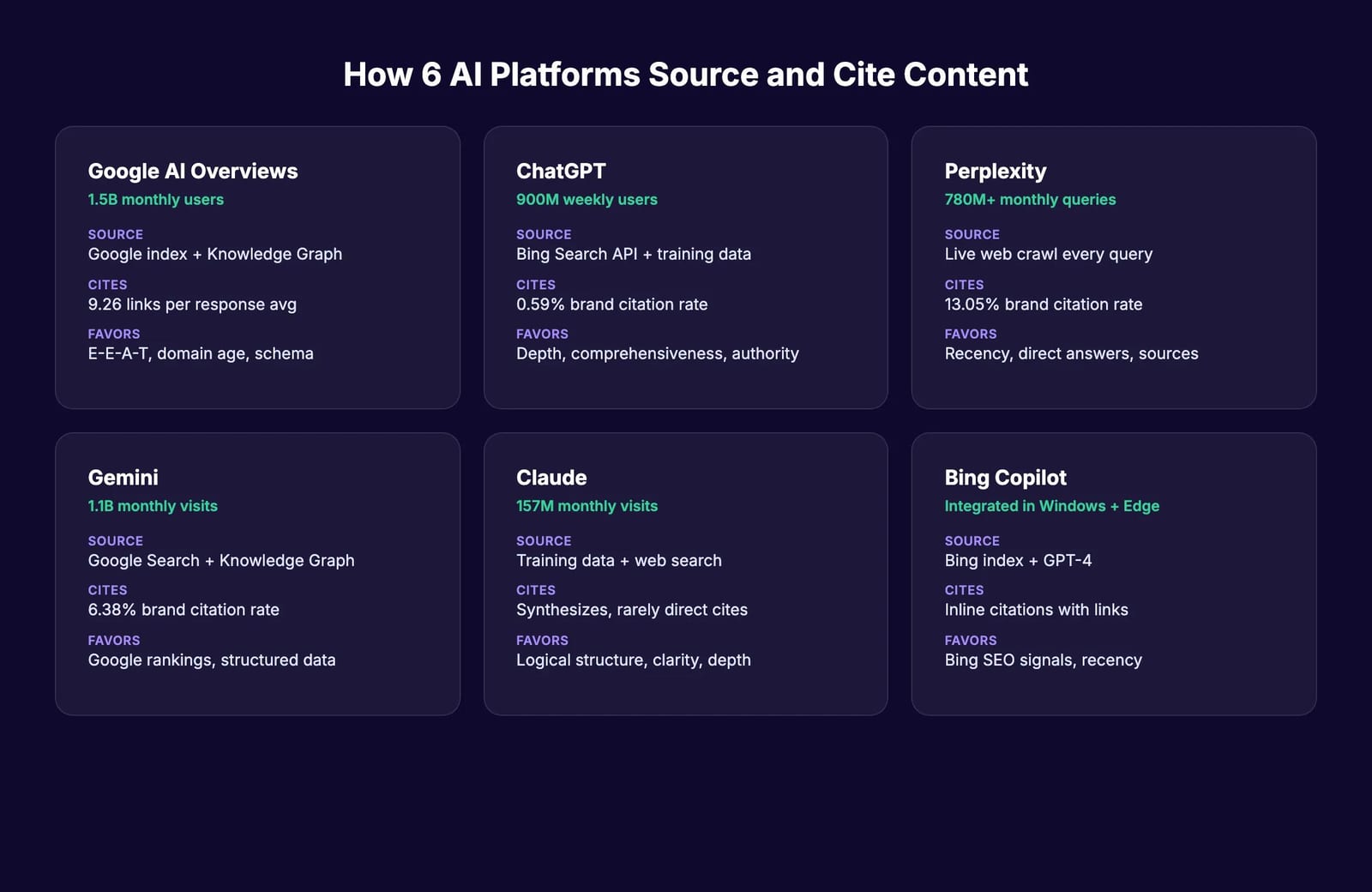
Different AI platforms also draw on different sources:
- Gemini cited YouTube in 113 answers. The other three platforms did not cite it once.
- Claude did not cite Reddit in any of its 240 answers.
- ChatGPT cited an average of 3.05 sources per answer, compared with 19.48 for Perplexity.
Being visible on one platform does not automatically make your brand visible on another.
A separate study by Writesonic, based on 161,286 prompts, also found that 72–73% of cited domains appeared on only one platform.
Source: Writesonic's AI citation study
Both studies point to a similar pattern, although their methodologies and platform combinations differ. They were also conducted by companies selling AI visibility measurement tools, so their findings should be read alongside their methodologies.
And not every store needs to prioritize AI visibility immediately. If your customers are not using AI assistants to discover and compare products, AEO may not be your most urgent investment.
How to measure your AI visibility without buying another tool
Before paying for an AEO audit or subscribing to another monitoring platform, start with a simple test.
Choose 3–5 questions customers ask before buying.
For example:
- Which brands offer certified organic cotton bedding?
- What should I look for when buying a silk duvet cover?
- Which products are suitable for sensitive skin?
Don't test only your brand name. Find out whether AI recommends your store when customers are looking for solutions.
Ask each question at least three times on every relevant AI platform.
Focus on the platforms your customers actually use: ChatGPT, Gemini, Claude or Perplexity.
Record:
- Whether your brand or products appear.
- Which competitors are mentioned.
- Which websites are cited.
- Whether the platform actually searched the web.
Keep each platform's results separate. One combined visibility score can hide important differences.
Check Google's AI visibility separately.
Google introduced Generative AI performance reports in Search Console in June 2026 and made them available to all websites from August 31.
The reports show impressions and pages appearing in Google's generative AI features, including AI Overviews and AI Mode.
However, they do not measure your visibility across ChatGPT, Claude, Gemini or Perplexity. The dedicated AI reporting focuses on impressions rather than providing a separate AI click metric.
Official source: Google Search Central
The takeaway
AI visibility is not a single ranking you can check with one question.
Before deciding that your store is invisible, measure it across the platforms your customers use, and repeat the test.
One missing citation is not a verdict. It's one data point.