All stories · Article
Shopify enables Poppy across every store, giving AI agents a recognized way to interact with merchants
Shopify has enabled Personal Agent Protocol (Poppy) for every merchant on its platform.
Share: WhatsApp · Telegram · X · Facebook · LinkedIn · Email

Announced by Sierra on November 13, 2026, the rollout means Shopify merchants do not need to install or configure anything to make their stores discoverable to personal AI agents through Poppy.
The move connects two important parts of agentic commerce: identifying the AI agent acting for a customer, and enabling that agent to shop through the merchant's existing commerce infrastructure.
What happened
According to Sierra's announcement, Poppy version 1.0 is now available, and Shopify has enabled it for every merchant on its platform.
Sierra also announced that:
- Meta Muse now looks for Poppy first on every website it visits.
- More than 100 companies have joined as Poppy design partners.
- Mercury, Synchrony, and Turkish Airlines are among the companies already going live with the protocol.
Sierra@SierraPlatformToday we’re releasing Personal Agent Protocol (Poppy) v1.0.
It’s on for everyone who uses Muse, @Meta's AI agent, enabled for every merchant on @Shopify, and backed by more than 100 design partners.Nov 13, 2026 · View on X
What Poppy actually does
Poppy is an open protocol developed by Sierra and Meta with industry partners. It defines how a personal AI agent identifies itself to a company, establishes a session on behalf of a user, and obtains permission to access services or account information.
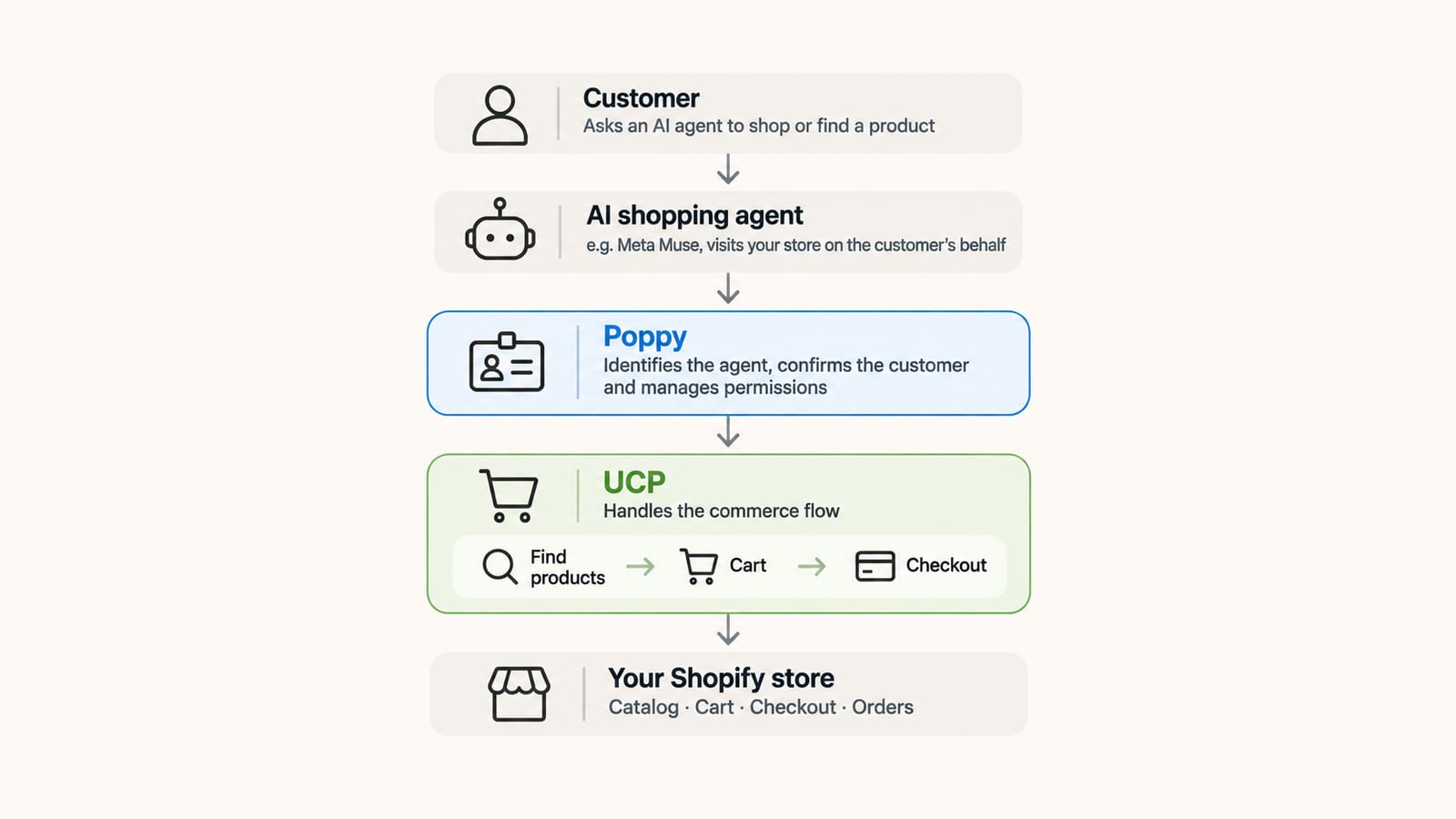
For merchants, the important change is that an AI agent can identify itself as an agent acting for a customer, rather than appearing as an ordinary website visitor.
How does a store recognize an AI agent?
The process works through a series of technical steps:
- Store publishes its Poppy information. Each participating website makes a
poppy.jsonfile available at/.well-known/poppy.json. This file tells AI agents which channels, APIs, and sign-in options the company supports. - Agent identifies itself in each request. The AI agent sends a
Poppy-Sessionheader containing a signed JSON Web Token (JWT). The token identifies the agent and includes a pseudonymous user ID representing the person it is acting for. - Store verifies the session. The store's system can verify the token and recognize which agent is making the request and which user ID it represents.
The user ID is not the customer's real name or email address. It is an opaque identifier that allows the company to recognize the same user across sessions without automatically revealing their identity.
If the agent needs access to the customer's account, Poppy uses OAuth sign-in. The customer authorizes the requested access, and the agent receives only the permissions granted.
In short, Poppy identifies the agent and the user it represents; OAuth controls what the agent is allowed to access.
Technical details are available in the Poppy 1.0 specification.
Poppy and UCP serve different roles
Poppy does not replace Shopify's Universal Commerce Protocol (UCP). The two protocols handle different parts of an AI-powered shopping journey.
| Protocol | Main role |
|---|---|
| Poppy | Agent identity, user sessions, permissions, and interactions with the merchant |
| UCP | Product discovery, cart operations, checkout, and other commerce activities |
Shopify also co-authored Poppy's commerce extension to connect the two protocols. This allows an AI agent to shop as a guest or sign in with a customer's account, while requiring customer approval for certain actions.
Sierra explains the distinction in its Poppy 1.0 announcement.
What this means for Shopify merchants
The rollout gives Shopify stores a standardized way to be discovered and approached by personal AI agents.
As agents such as Meta Muse begin looking for Poppy automatically, merchants can prepare for a shopping journey in which customers may delegate product research, order-related tasks, or other interactions to AI.
The broader implication is not simply that AI agents can visit more stores. It is that merchants can begin interacting with them through a protocol designed to identify the agent, establish the user's permissions, and connect those interactions to commerce systems.
Poppy provides the identity and permission layer. UCP provides the commerce layer. Together, they help make agent-led shopping more structured and interoperable.
Sources · 4 · sierra.ai, x.com, personalagentprotocol.org
Ask AI next
- How can merchants check whether Poppy and agent traffic are actually active on their store?
- Can merchants customize or opt out of what their poppy.json file exposes to AI agents?
- How does a merchant's system verify a Poppy JWT isn't spoofed or forged by a bad actor?
- Are other e-commerce platforms besides Shopify planning to adopt the Poppy protocol?
- What tools can merchants use to test or debug their poppy.json and Poppy-Session setup?