All stories · Hot News
OpenAI launches Businesses in ChatGPT, giving companies control over how they appear on ChatGPT
Claiming gives businesses control over their information and access to performance insights. It does not buy them better rankings or more sales.
Share: WhatsApp · Telegram · X · Facebook · LinkedIn · Email

On November 10, 2026, OpenAI launched Businesses in ChatGPT, a beta program that allows businesses to claim their profiles, update company information, and see how people interact with them on ChatGPT.
The announcement also came with a Shopify push. Merchants can now claim their business profiles directly through the new ChatGPT Business app in Shopify admin, previously called the ChatGPT Ads app.
For Shopify sellers, the distinction matters: claiming your profile is not what gets your products into ChatGPT. It gives you more control over how your business is represented there.
Here's what that actually means before Black Friday.
What a claimed profile actually gives you
Once a business claims and verifies its profile through Business Hub, it gets three main capabilities.
A verified business profile.
Businesses can update key information, including their business description and contact details. A blue checkmark appears on the profile to indicate that the business has been claimed.
This gives sellers a way to correct outdated or inaccurate information that ChatGPT may use when answering customer questions.
Insights into how ChatGPT references your business.
Business Hub provides aggregated data on:
- Mentions: How often ChatGPT references your business.
- Website clicks: Clicks on links to your website from supported ChatGPT surfaces.
- Discovery topics: Common themes across conversations in which ChatGPT cites your website.
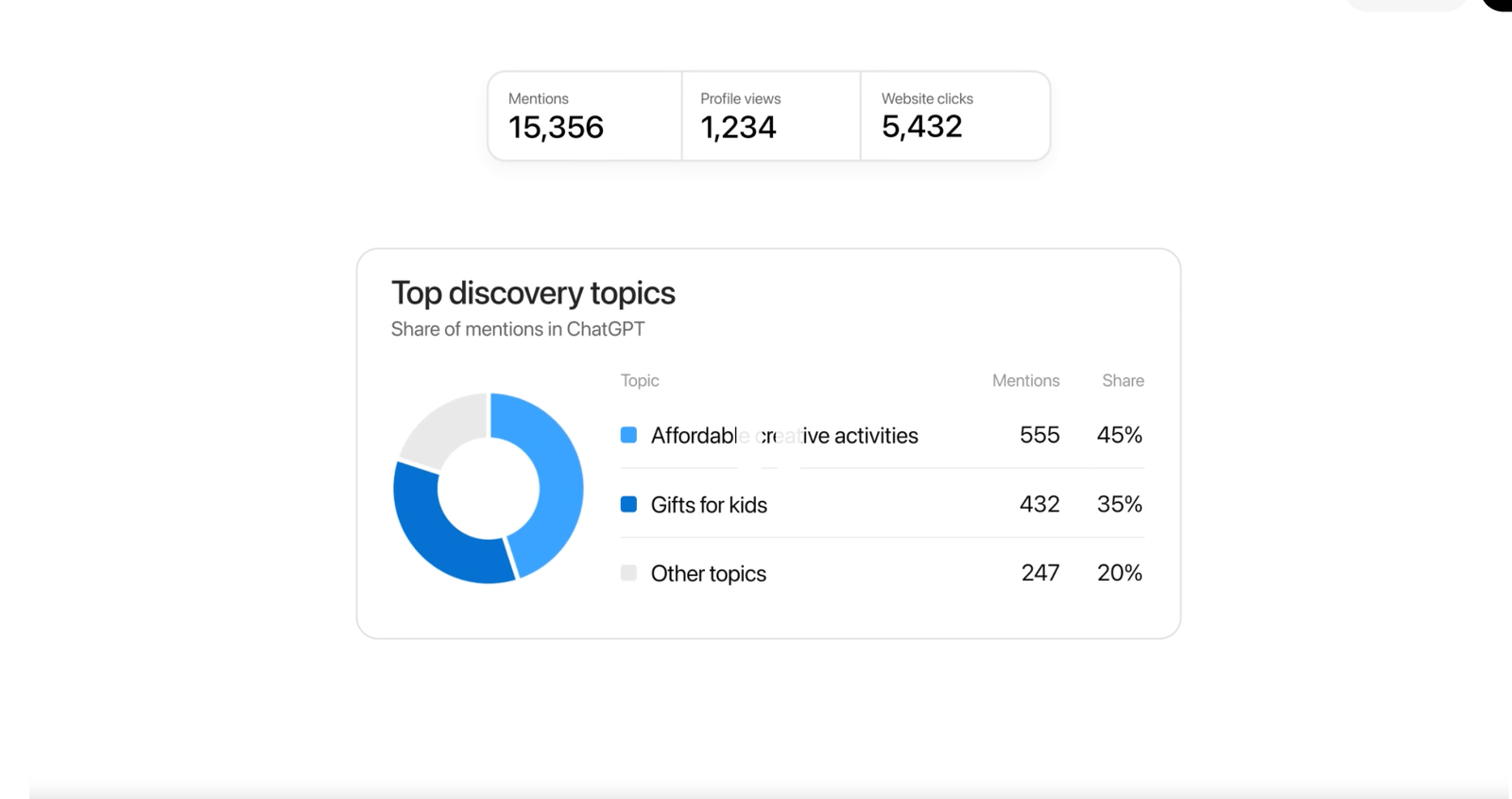
These insights help businesses understand how they appear in ChatGPT and what topics are associated with their websites.
However, businesses cannot see individual prompts, private conversations, or share of voice against competitors. Insights are also withheld until activity reaches certain thresholds.
Sources: OpenAI announcement | Digiday interview with OpenAI
A Business Agent, if eligible.
Eligible ecommerce and online service businesses based in the United States can create a Business Agent.
Think of it as a branded AI assistant inside ChatGPT. Customers can ask questions about products, compare options, and get recommendations using information and instructions supplied by the business.
The conversation is clearly labeled as a business interaction and remains separate from ChatGPT's independent responses.
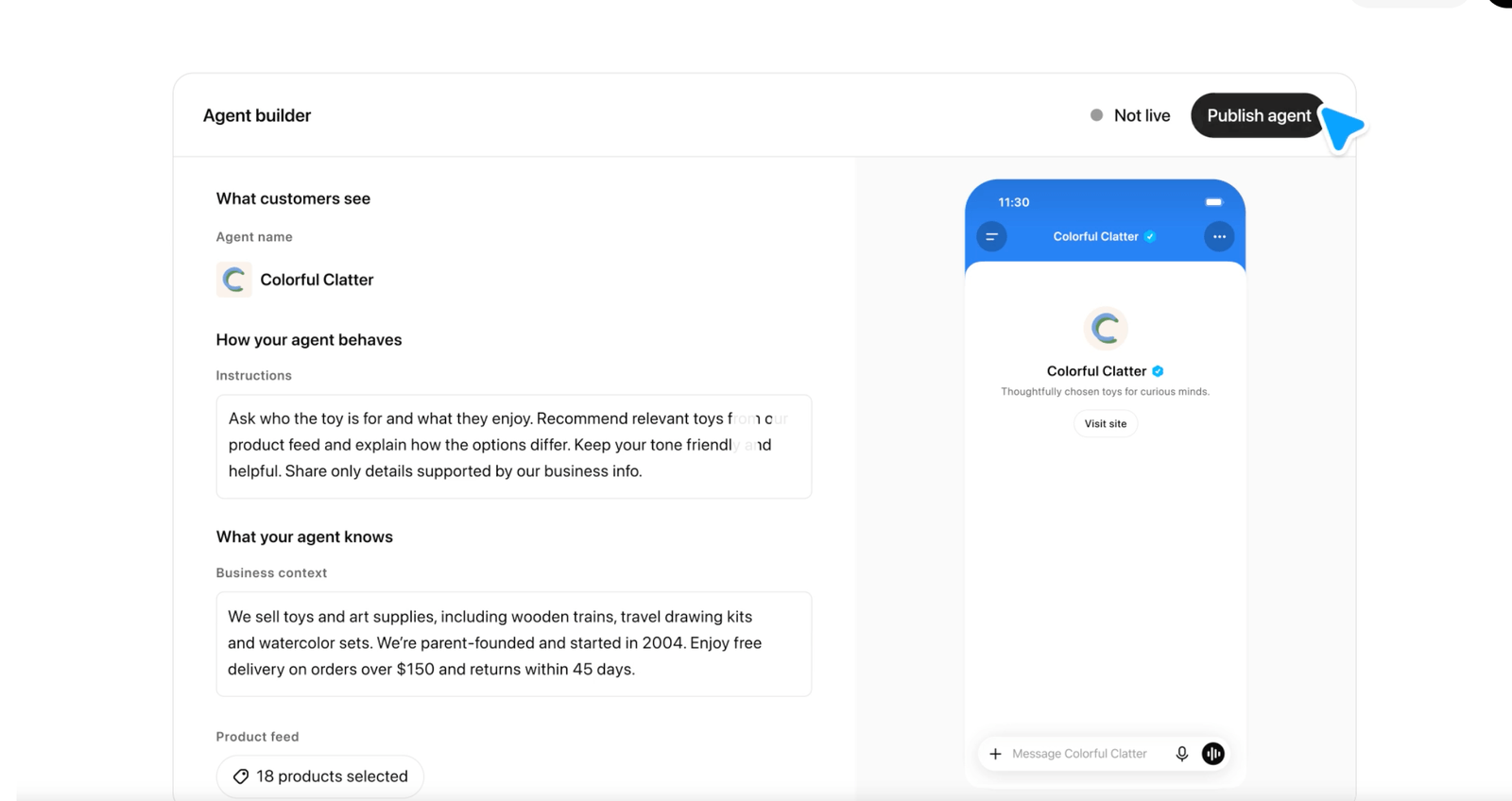
It is an additional way to engage interested shoppers, not a replacement for the store's checkout.
What OpenAI says claiming won't do
This is the most important distinction in the announcement.
Claiming your business does not guarantee higher placement in ChatGPT recommendations or more sales.
OpenAI explicitly states this in its official Business Hub FAQ.
ChatGPT continues to make independent recommendations and comparisons, whether or not a business has claimed its profile.
OpenAI's VP of Monetization, Benji Shomair, reinforced the point in a briefing reported by Digiday. He said claiming a business should not affect how frequently it appears in ChatGPT.
There is a nuance, though. Shomair also said that more accurate business information could help ChatGPT surface a business in more relevant conversations because the platform has a clearer understanding of what it offers.
That is different from buying a better ranking.
Better information may improve relevance. It does not guarantee visibility.
The fine print Shopify sellers should know
Not every feature is available to every merchant.
Business profiles and insights are available globally, but Business Agents are currently limited to eligible businesses based in the United States.
A seller based outside the US can still claim a profile and access business insights, even if they sell to American customers. Selling into the US does not make an overseas-based store eligible for a Business Agent.
There is also no need to build another product feed just to claim a profile.
Shopify confirms that eligible products are already discoverable in ChatGPT through Shopify Catalog, with pricing and availability kept up to date.
Installing the ChatGPT Business app is optional. It is not a requirement for selling through ChatGPT.
Other limitations matter:
- No direct checkout through the Business Agent. The agent helps customers explore products and answer questions. Purchases are completed through the merchant's online store checkout.
- A click is not a conversion. Website clicks in Business Hub do not confirm completed visits, purchases, or revenue.
- No individual customer conversations. Businesses cannot inspect the prompts or private chats behind their insights.
- No guaranteed control over profile content. OpenAI's terms allow it to supplement, replace, or decline information submitted by businesses.
Sources: Shopify Help Center | OpenAI Business Hub FAQ | OpenAI Businesses in ChatGPT Terms
So why claim before Black Friday?
If claiming does not guarantee better rankings, why spend time doing it now?
Because ChatGPT may already be talking about your business.
OpenAI confirms that it can display business information whether or not the business has claimed a profile or published a Business Agent.
That means a merchant who has never claimed their profile may still appear in product recommendations and relevant conversations.
The difference is that claiming gives the business a way to update its information and access aggregated insights about how it appears.
For Shopify sellers, the timing is particularly relevant.
Black Friday falls on November 27 this year. As shoppers use AI tools to research products, compare alternatives, and narrow down their choices, accurate product and business information becomes increasingly important.
A Business Agent is another potential touchpoint for eligible US merchants. It can answer product questions and help shoppers compare options before sending them to the store to complete a purchase.
Greg Isenberg, CEO of Late Checkout, described the development as potentially comparable to Google My Business for the AI era. The analogy captures the shift toward businesses managing their presence on AI discovery platforms, although ChatGPT's profile system is not identical to Google's local business listings.
The bigger point is that businesses can now access first-party insights from OpenAI itself, rather than relying entirely on third-party tools to estimate their visibility.
For now, Business Hub and Business Agents are free. OpenAI has not ruled out introducing paid options in the future, according to Digiday.
Claiming your profile from Shopify admin
For Shopify merchants, the process is relatively straightforward.
Step one: Open Shopify admin and navigate to Sales channels > Agentic.
Step two: Find ChatGPT under Channels and install the ChatGPT Business app.
Step three: Go to Apps > ChatGPT, click Get started, and connect the ChatGPT account you want to use.
Step four: Claim your existing business profile or create one if no matching profile exists.
If another party has already claimed the profile, Shopify provides an option to dispute ownership.
Step five: Once claimed, review your business information in ChatGPT Business Hub. Check the business description and contact details first.
If your store is eligible for a Business Agent, you can also add product knowledge and instructions, test its responses, and publish it when ready.
Full instructions: Shopify Help Center - Selling on ChatGPT
Claiming your ChatGPT profile is not a shortcut to better rankings. It is a way to make sure the information representing your business is accurate and to start measuring how ChatGPT references your store.
Have you claimed your business profile yet? More importantly, have you checked what ChatGPT is currently saying about your store?
Ask AI next
- How can you check what ChatGPT is already saying about your store before you even claim your profile?
- What third-party tools can reveal your ChatGPT share-of-voice against competitors, since Business Hub won't show it?
- What specific signals does ChatGPT actually weigh when deciding which businesses to recommend in a conversation?
- Are rival AI assistants like Google AI Mode or Perplexity rolling out similar business-claiming profiles for merchants?
- What early signs would indicate OpenAI is shifting toward paid placement or ranking boosts inside ChatGPT?