All stories · Case study
How an apparel brand reached 2.97 ROAS on Google Ads in 6 months
An apparel brand went from no Google Ads history to $1.21M in monthly Google revenue on $408K of spend, by splitting cold-traffic campaigns by format and collection.
Share: WhatsApp · Telegram · X · Facebook · LinkedIn · Email

According to @mrfeldmanSEM, an apparel brand that had never run Google Ads six months earlier made $1.21M in Google revenue last month on $408K spend, a 2.97 ROAS. These are figures reported by the agency that ran the account.
Daniel Feldman | Google Ads@mrfeldmanSEM6 months ago, this apparel brand had NEVER run Google Ads.
And last month Google alone brought in $1.21M in revenue on $408K in spend, a 2.97 ROAS.
So this is EXACTLY how we got there:
1. Started small, on cold traffic
We launched at $500 a day.
Brand campaigns got no more than 20% of the budget, and the other 80% went into non brand Search and Shopping.
Since the account was brand new, those brand conversions…Nov 9, 2026 · View on X
Before
According to @mrfeldmanSEM, the brand had never run Google Ads. The account was brand new, so there was no prior revenue, spend or ROAS on Google. The post gives no baseline for the brand's overall sales, margins or traffic from other channels.
What they changed
- Started small on cold traffic. They launched at $500 a day. Brand campaigns got no more than 20% of the budget; the other 80% went to non-brand Search and Shopping. Brand conversions helped feed the new account with data early on.
- Uploaded every customer. They imported all the brand's Shopify customers from every source, including people who never joined the email list, so Google had more to learn from and non-brand campaigns converted faster.
- Found the 2 collections carrying the account. The brand had 8 collections running together. Two, built around one specific style of design, performed far better. Each got its own campaign and budget, which made Shopping easier to scale.
- Added Demand Gen at $2K to $3K a day. They ran static promo ads with the offer in the headline, sent straight to the product page. In-platform ROAS looked close to break even, but Triple Whale showed a high share of new visitors and branded searches kept climbing. @mrfeldmanSEM says those people came back through Search and Shopping when ready to buy.
- Launched a lot of video. They moved 10 to 20 of the brand's best Meta ads to YouTube, then kept launching 5 to 10 new videos a day based on what was working.
- Gave every format its own campaign. AI UGC, real UGC, product demos and promo videos each got a separate YouTube campaign, making new visitor rate, CAC and impact per format visible.
The post describes the account as one loop: Demand Gen and YouTube bring new people in, and Search and Shopping catch them when they are ready to buy.
After
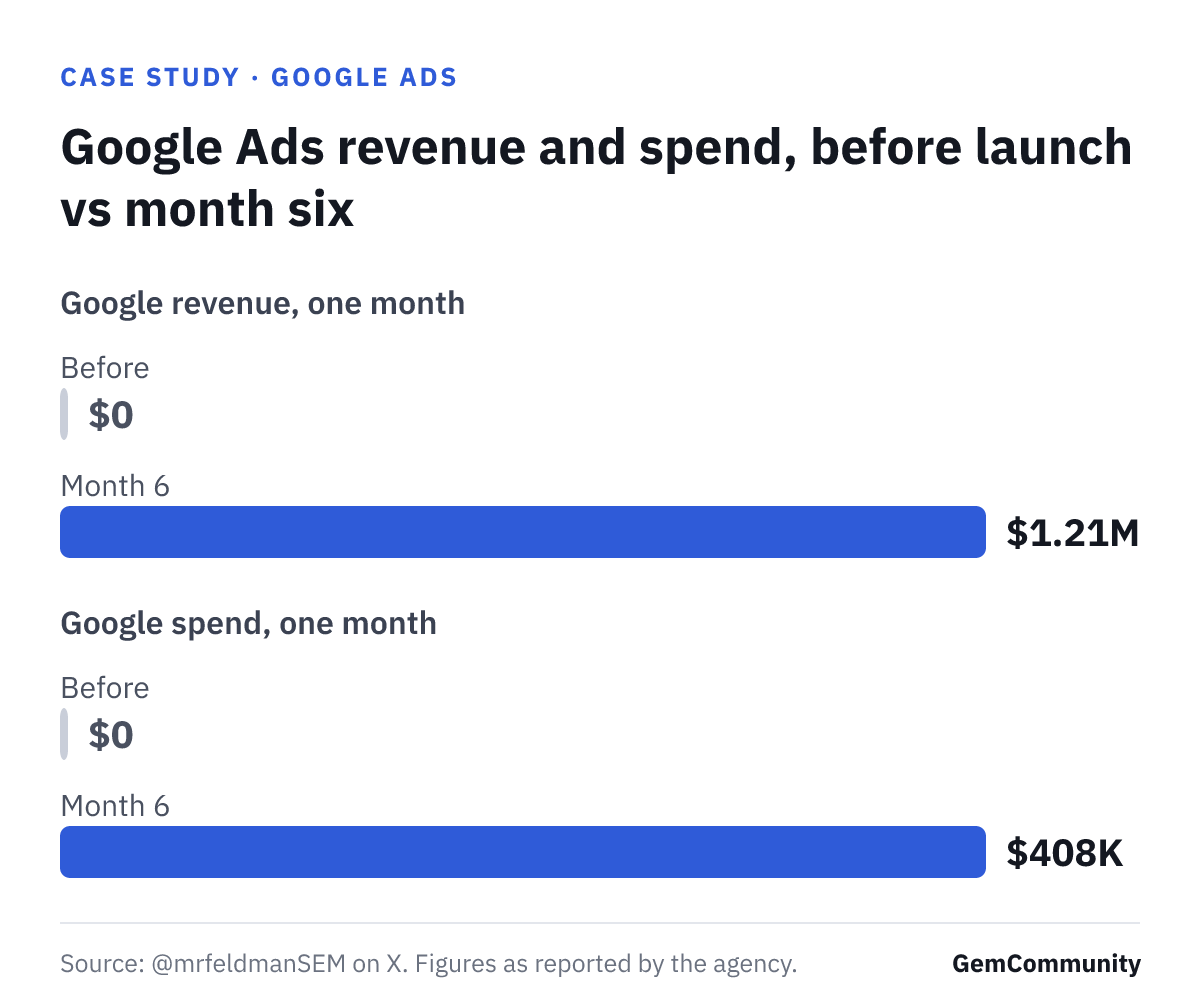
All figures are self-reported by @mrfeldmanSEM; the post does not say how revenue was attributed beyond "Google alone."
- Google Ads revenue: $1.21M last month, from $0 before launch.
- Google Ads spend: $408K last month, from $0.
- ROAS: 2.97, from no prior Google Ads history.
- Timeline: six months from first launch to the figures above.
The post does not break out revenue or spend by campaign type, so you can't tell how much Demand Gen or YouTube contributed directly.
How can you test this on your store?
- Cap brand search at 20% of a new account's budget and put the rest into non-brand Search and Shopping. Track non-brand conversions per week.
- Import your full Shopify customer list, not just email subscribers, as a customer list in Google Ads. Compare time to first non-brand conversions with and without it.
- Check which of your collections drive most revenue in Shopping. Give the top one or two their own campaign and budget, and watch ROAS per campaign over four weeks.
- Test a small Demand Gen budget with static offer ads linking to product pages. Judge it by new visitor share and branded search volume, not in-platform ROAS alone.
- Put each video format (UGC, demo, promo) in its own YouTube campaign and compare new visitor rate and CAC after two to four weeks.
Frequently asked questions
Which brand is this?
The post only says "this apparel brand" and calls it a client. @mrfeldmanSEM does not name it, so the result can't be checked against a public store.
Who reported the numbers, and can you trust them?
@mrfeldmanSEM posted them, and the account has a stake: the post ends by inviting stores spending $1K+ a day on Google to DM for an account review, and the profile advertises Google Ads scaling services. The figures are self-reported and unaudited, so treat them as one agency's claim.
Is $1.21M the total over six months?
No. The post says Google alone brought in $1.21M revenue on $408K spend "last month," which is the sixth month. It is not a six-month total.
Does this work without a big budget?
The account started at $500 a day but Demand Gen later ran at $2K to $3K a day, and the offer is aimed at stores spending $1K+ a day. The post gives no results for smaller budgets.
Sources · 1 · x.com
Ask AI next
- What's the best Google Ads campaign structure to give each top-performing collection its own Shopping campaign?
- Why does uploading non-email customers via Customer Match help Google Ads learn and convert faster?
- Does this Demand Gen plus YouTube to Search and Shopping loop work for non-apparel D2C brands too?
- What tools can measure new-visitor share and branded-search lift from Demand Gen ads without Triple Whale?
- What early signals suggest this Demand Gen to Search and Shopping loop is losing effectiveness or CAC is rising?