All stories · Article
Creative diversity is becoming a performance priority
*Meta is putting more emphasis on creative diversity, from its advertising guidance to a new Ads Manager metric. For Shopify sellers using AI to produce more ads, the question is no longer just how many variations they can make, but how different those variations actually are.*
Share: WhatsApp · Telegram · X · Facebook · LinkedIn · Email

Meta is sending a clear signal: creative diversity matters
For years, advertisers have focused heavily on audience targeting: interests, lookalikes, demographics and audience segments.
But as Meta's AI takes on more of the work of finding potential customers, creative is becoming a more important variable that advertisers can directly influence.
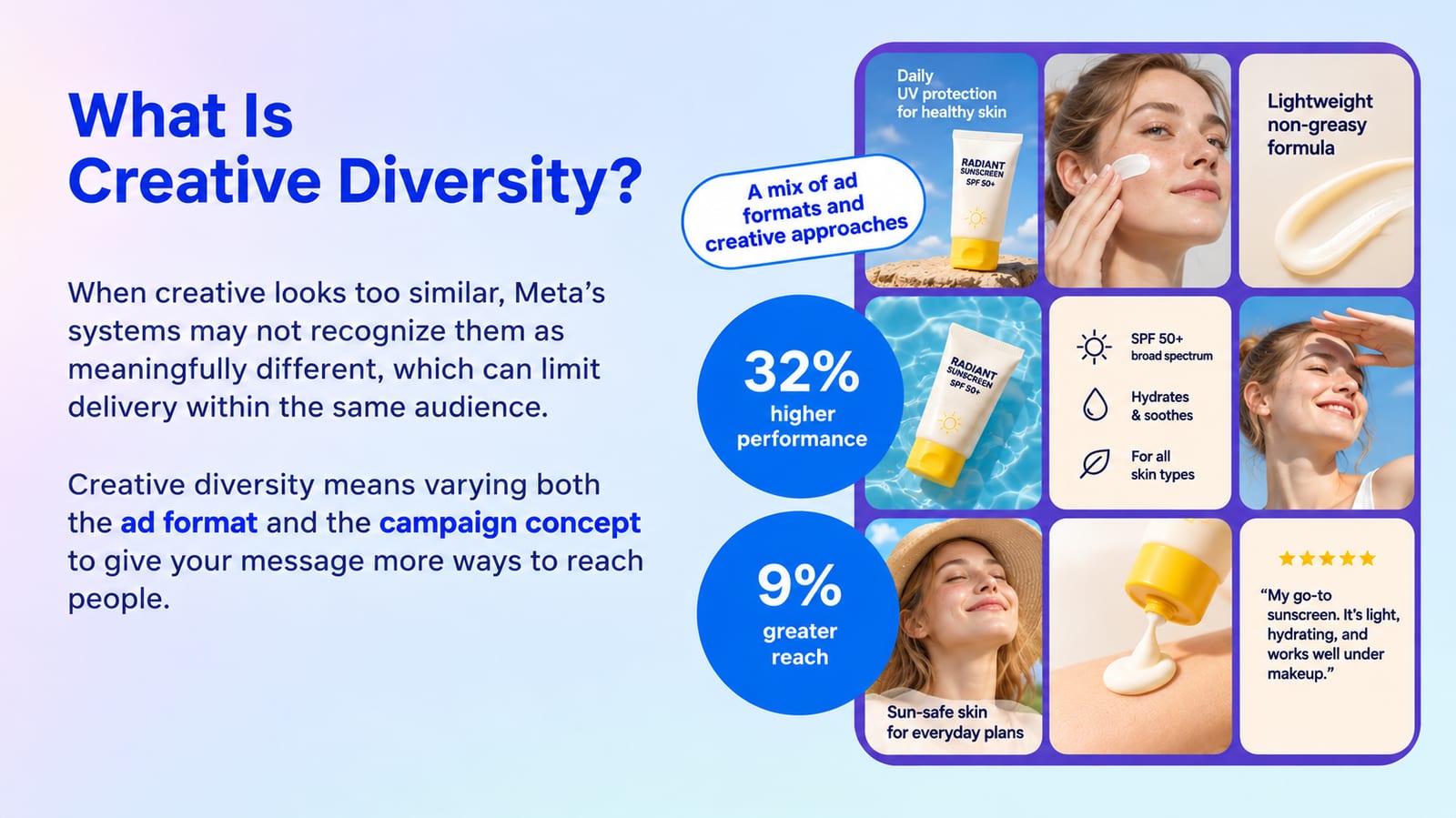
Meta's recent guidance and product developments point in the same direction: advertisers need to give the system meaningfully different creative, not simply a larger number of ad files.
Three developments make this particularly clear.
Different creative can produce different results
In its March 2026 Meta Blueprint training on creative diversification, Meta states that visually distinct creatives can achieve up to 32% higher performance compared with similar creatives, based on large-scale ad tests.
This is an important distinction.
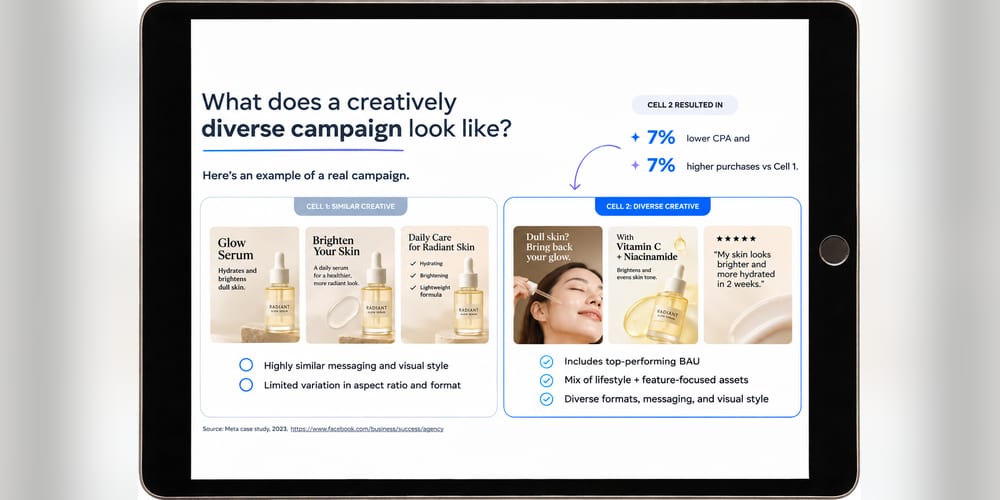
The message isn't simply to make more images or videos. It's to introduce creative assets that look and communicate differently enough to offer new ways of connecting with audiences.
The 32% figure is an upper-end result reported by Meta, not a guaranteed improvement for every advertiser.
Repetitive creative can become expensive
Meta's Top Trends 2025 report provides another reason to pay attention.
It reports an average 60% drop in conversion after four repeated exposures to similar creative, based on an analysis of 147,610 purchase-optimized advertising accounts in 2021.
The same report identifies creative diversification as an opportunity to reach more people and drive more sales. It recommends diversifying three areas:
- Messaging
- Messenger
- Formats
Source: Meta - Top Trends 2025, Creative Boom, page 10
The finding matters because creative fatigue is not necessarily solved by changing a product image or producing another version of the same ad.
If the audience keeps seeing essentially the same message, a new file may not provide a meaningfully new experience.
Meta is starting to measure creative diversity
Perhaps the strongest signal came in August 2026.
According to Search Engine Land's report, Meta introduced a Creative Diversity metric in Ads Manager, accessible through:
Columns → Customize Columns → Creative Diversity
The metric estimates how visually diverse the images and videos within campaigns and ad sets are. It currently has three ratings:
- Low
- Medium
- High
The metric is labelled "In development", so it should not be treated as a definitive measure of creative quality or campaign performance.
But its introduction is significant.
Meta is beginning to make creative diversity visible in the reporting interface, rather than leaving it as an abstract recommendation in marketing guidance.
Meta's creative diversity signals
A three-part visual:
- Up to 32% higher performance: visually distinct vs. similar creatives.
- 60% average conversion decline: after four repeated exposures to similar creative.
- Creative Diversity metric: Low / Medium / High in Ads Manager.
Caption: Meta is increasingly treating creative diversity as something advertisers should actively build and monitor.
What does Meta mean by creative diversity?
Creative diversity is not simply having different images, headlines or product variations.
Meta Blueprint's creative diversification course specifically teaches advertisers to diversify by:
- Concept: Different ways of presenting a product or communicating its value.
- Motivation: Different reasons customers might want to buy.
- Format: Different ways of delivering the message.
This is more useful than treating every new asset as a new creative idea.
Consider a skincare product.
| Creative approach | What changes |
|---|---|
| Problem-led | Start with the customer's frustration with dry skin |
| Product demonstration | Show texture, application and product use |
| Customer testimonial | Communicate the experience of an actual customer |
| Ingredient-led | Explain what makes the formulation different |
| Lifestyle | Show the product within a relevant daily routine |
All five ads can sell the same product. But they approach the customer through different motivations and experiences.
That is the difference between producing more assets and building creative diversity.
Why this matters for AI-generated advertising
The recent Dreamina promotion wave on X offers a useful example.
Between November 6 and 7, at least 29 accounts in the reviewed sample published near-identical promotional messages. The recurring pitch was to choose a template, upload a product, adjust the model and generate an ad.
Some posts explicitly described the approach as:
"Same creative framework. Your own product."
Amalia@AmaliarenzyChallenge: Can you turn an existing ad template into your own product campaign?
I gave it a try with Dreamina Marketing Studio.
The process was simple:
1. Find an eye-catching template.
2. Upload a product.
3. Customize the model and settings.
4. Generate a brand-new creative.
The result? A fresh product ad inspired by an existing creative concept, without having to start from scratch.
Now it's your turn. What would…Nov 6, 2026 · View on X
The approach can help sellers produce more product variations quickly. But it also raises a question about what is actually changing.
If the hook, composition, storyline and sales message remain the same, swapping the product may create another asset without creating a new creative direction.
This doesn't mean template-based production is ineffective. It can be useful for expanding a proven concept across SKUs or creating seasonal variations.
The mistake is assuming that more template variations automatically mean more creative diversity.
AI can help sellers produce creative at scale. But the seller still needs to decide which ideas are worth producing.
How Shopify sellers should build creative diversity
Rather than starting with a target number of ads, start by examining the creative approaches already present in the account.
| What your account already uses | What to introduce |
|---|---|
| Product-focused hooks | Customer problem or curiosity-led hooks |
| Discount-led messaging | Quality, convenience or product outcomes |
| Studio product photography | UGC or lifestyle content |
| Feature explanations | Demonstrations and real-world use |
| Brand-led claims | Customer reviews and creator perspectives |
A practical testing workflow:
Audit: Group existing ads by concept, message, format and visual approach. Identify repeated patterns.
Diversify: Choose two or three genuinely different directions, rather than producing ten cosmetic variations.
Test: Compare the new concepts with an existing control creative, keeping budget, audience and testing period as consistent as possible.
Learn: Look beyond the number of ads produced. Evaluate CTR, CPA, ROAS and other metrics relevant to the campaign objective.
There is no universal number of creatives every store needs. The goal is to build enough meaningful variety to discover which approaches resonate with customers.
The takeaway: creative diversity is becoming a performance discipline
Meta's message is becoming harder to ignore.
Its training materials highlight the performance potential of visually distinct creative. Its research points to the cost of repeated exposure to similar ads. And its new Ads Manager metric makes creative diversity increasingly visible to advertisers.
For Shopify sellers, this changes how AI-generated advertising should be evaluated.
The question is not whether AI can produce 10, 20 or 50 ads in minutes.
The question is whether those ads give Meta and your audience genuinely different ways to experience the product.
The next competitive advantage in paid social may not come from producing more creative. It may come from producing more meaningful differences.