All stories · Article
An underrated Shopify update: its Catalog now includes non-Shopify brands
Shopify merchants are no longer the only brands that can appear in its expanding product catalog. A new Catalog API update lets AI-powered shopping experiences discover products from brands that don't sell on Shopify.
Share: WhatsApp · Telegram · X · Facebook · LinkedIn · Email

But there's an important distinction: those brands can get discovered, while Shopify merchants retain a more direct path to checkout inside supported AI agents.
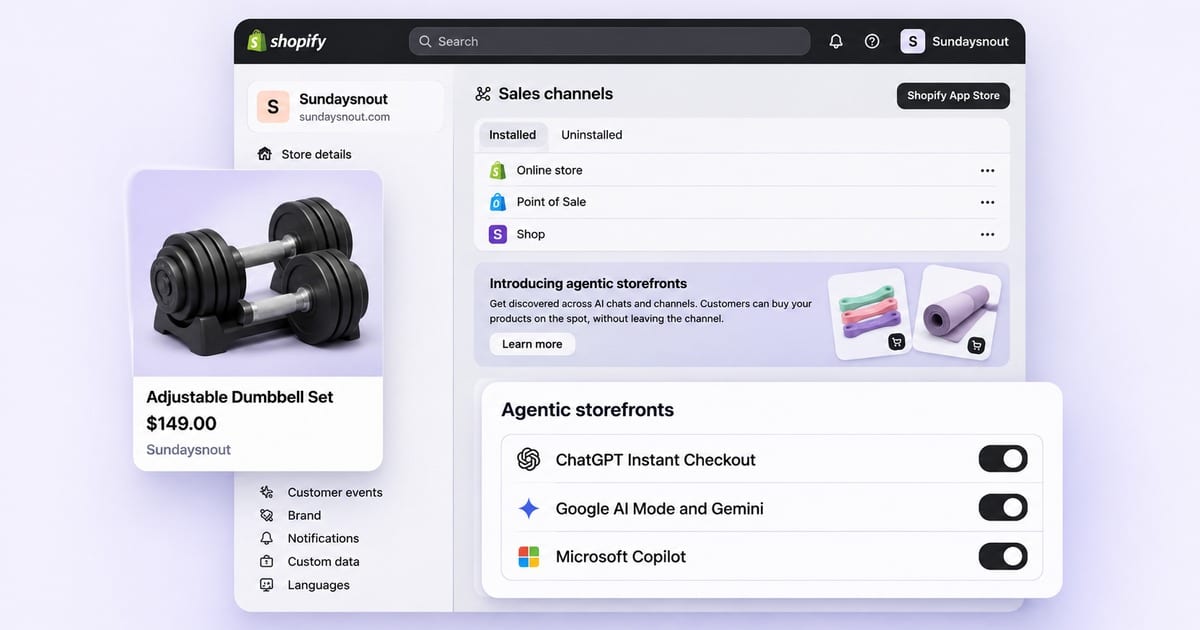
For merchants, that changes the competitive landscape. Your store may be standing next to brands that don't use Shopify at all. And when shoppers complete their purchases inside an AI conversation, the theme, reviews, upsells, and other storefront features you've invested in may not follow them to checkout.
One product catalog, two different buying journeys
On October 27, Shopify updated its beta Catalog API to include products from brands that don't sell on Shopify. Developers can now use the sources parameter to return Shopify merchant products, external products, or both in the same catalog search.
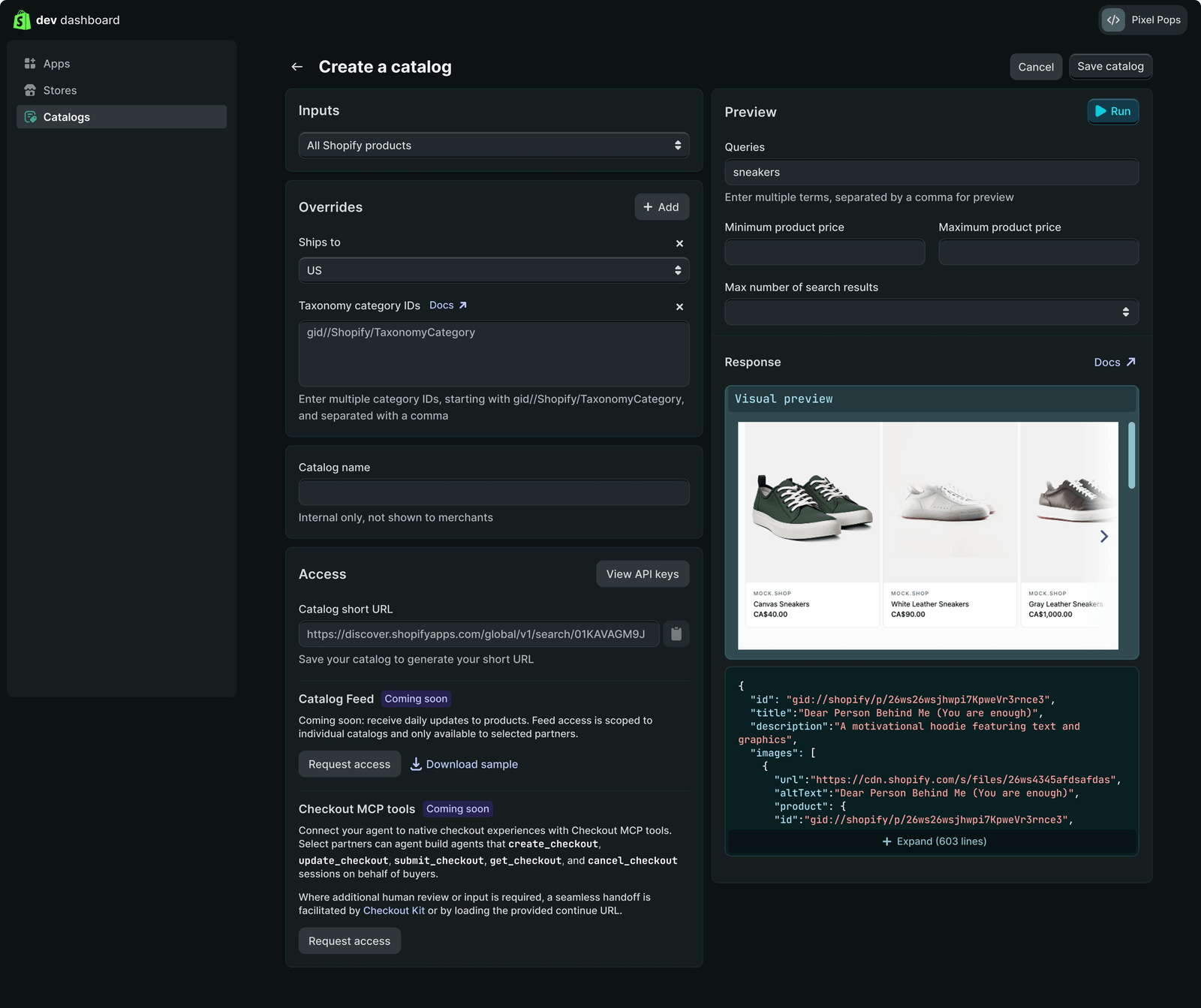
External listings include product descriptions, images, prices, and links to the brand's own product pages. They don't support native Shopify checkout: shoppers must leave the AI shopping experience and complete their purchases on the brand's website.
There are two important limitations. The external-product feature is still in beta, and these products are currently returned only when the shopper is in the United States.
The announcement received attention from Gil, who works on Shopify's agentic commerce infrastructure, describing the Catalog expansion as an underrated Fall '26 announcement.
The takeaway: Shopify is building a shared discovery layer, but the path from discovery to purchase is not the same for every brand.
Sources: Shopify Developer Changelog - External brands in Catalog API · Shopify Catalog documentation · Gil's post on X
The storefront is no longer the only place where competition happens
This expansion also connects to a broader question raised by Philip Qiu: what happens to Shopify's competitive advantage when shopping moves away from traditional storefronts?
His argument is that many Shopify apps and features are designed around a human shopper browsing a website. But an AI agent doesn't necessarily interact with a store the way a person does. It can discover products, compare options, and initiate purchases without ever visiting the merchant's homepage.
Shopify's decision to include products from non-Shopify brands in its Catalog reinforces that shift. A brand no longer needs a Shopify storefront to enter this discovery layer.
That doesn't mean Shopify has abandoned storefront commerce, or that its platform advantage has disappeared. It means the competitive battleground is expanding beyond the website itself.
Source: Philip Qiu's argument on X
Philip Qiu@PhilipQiu5The case for why Shopify will lose agentic commerce:
First, let's start with the obvious advantages.
> Massive merchant network effects. Distribution is largely built in.
> Deep ecosystem of apps built around those merchants
> Millions of user credentials stored through ShopPay
Here's why their vulnerable:
> Agentic commerce creates a world where shopping moves off of the storefront. The vast majority of their…Nov 8, 2026 · View on X
Do your theme and apps actually reach the agent checkout?
The difference becomes more concrete when looking at Google AI Mode and Gemini, where Shopify supports direct checkout inside the AI shopping experience.
According to Shopify's Help Center, certain storefront and checkout customizations may not be available in these agentic checkouts.
Examples include:
- Upsells and add-ons: Blocks that change the cart, add products, or offer additional purchases may not load.
- Reviews and trust badges: Informational blocks, including reviews and trust badges, might not appear.
- Loyalty features: Loyalty and rewards experiences may be unavailable.
- Tracking: Google Analytics and custom client-side pixels don't fire in these checkouts.
- Bundles and subscriptions: Product bundles and subscription-only products aren't supported for direct checkout.
This matters because merchants often spend considerable time and money optimizing these elements to improve conversion rates.
However, there's an important distinction: these limitations are documented specifically for Google AI Mode and Gemini. They should not automatically be generalized to every AI agent or every agentic checkout.
The storefront experience you've designed for a human shopper doesn't automatically transfer to an AI agent's checkout.
Source: Shopify Help Center – Selling on Google AI Mode and Gemini
Where Shopify merchants still have an advantage
Despite the growing competition, Shopify merchants retain two meaningful advantages.
First, the path to purchase can be shorter.
External products in the Catalog API return native_checkout: false. Shoppers are directed to the brand's website to complete their purchases.
By contrast, eligible Shopify products can support direct checkout within participating AI shopping channels. The shopper doesn't necessarily need to leave the conversation to buy.
Second, important checkout logic still works.
Shopify Functions are custom business rules that run during commerce operations. They can handle things such as shipping rules, discounts, and cart or checkout validation.
Shopify confirms that supported Functions, automatic discounts, and discount codes continue to work in Google AI Mode and Gemini direct checkout.
That gives Shopify merchants a way to preserve some of their commercial advantages even when the traditional storefront interface is absent.
There is one further nuance: Shop Pay can also facilitate purchases from brands outside Shopify in Claude Duet, Instinct, and Grok Bot. Muse, however, currently supports Shop Pay only for Shopify stores. So payment access alone is not an exclusive advantage for Shopify merchants.
Sources: Shopify Catalog API · Google AI Mode and Gemini checkout documentation · Shop Help Center - Personal AI agents
What merchants should check this week
Shopify's Q3 2026 earnings call offers an important reality check. The company said agentic shopping volume was still small, even as AI traffic grew 2.6x year over year and orders increased 3.3x. AI channels were sending shoppers directly to product pages at three times the rate of organic search, while Catalog-powered searches converted at twice the rate of general AI search.
These are Shopify-reported figures, not independently verified industry-wide benchmarks. Still, they suggest that product discovery through AI is becoming a meaningful channel worth preparing for.
Three practical checks:
- Check your Catalog eligibility. Go to
Sales channels > Agenticin Shopify Admin. Confirm whether your products are included in Shopify Catalog and review any ineligibility warnings. - Audit your checkout apps. List the apps and customizations your checkout depends on. Identify which ones may not appear or function in Google AI Mode and Gemini.
- Review your product data and offers. Make sure titles, descriptions, images, variants, and pricing are accurate and structured clearly. If you rely on bundles or subscriptions, understand that these products have specific direct-checkout limitations.
One final point is worth keeping in mind: AI shopping does not make the storefront obsolete. Shopify itself says AI channels are still sending substantial traffic to product pages. The smarter move is to prepare for both journeys rather than optimize for only one.
The competitive advantage is shifting. In agentic commerce, being easy for an AI to understand and easy for a shopper to buy may matter as much as having a well-designed storefront.