All stories · Article
Adobe tracks 18 product categories: 6 of 8 disclosed discount forecasts edge lower in 2026
Adobe's 2026 U.S. holiday shopping forecast is based on more than 1 trillion visits to retail websites, 100 million SKUs and 18 product categories. Its outlook suggests that peak holiday discounts will remain broadly in line with the previous season.
Share: WhatsApp · Telegram · X · Facebook · LinkedIn · Email

In the category-level figures Adobe published, six of eight categories are forecast to have slightly shallower discounts than their 2025 comparison benchmarks. Only toys and computers are expected to see deeper discounts.
The differences are relatively small, ranging from 0.1 to 1.2 percentage points in most categories. But the pattern raises a practical question for retailers: when competitors are offering similar discounts, what else makes shoppers choose one store over another?
For Shopify sellers, that question now extends beyond the storefront. Consumers are increasingly using AI to research products and compare prices, while Shopify is building infrastructure that allows compatible AI agents to interact with product catalogs, carts and checkout.
Discounts are staying close to 2025 levels
Adobe's forecast covers 18 product categories, but its September announcement provides specific peak-discount estimates for eight major categories:
| Product category | 2026 forecast | 2025 comparison | Change |
|---|---|---|---|
| Electronics | 30% | 30.1% | -0.1 pp |
| Toys | 29% | 28% | +1.0 pp |
| TVs | 23% | 24.2% | -1.2 pp |
| Computers | 23% | 22.8% | +0.2 pp |
| Apparel | 23% | 23.2% | -0.2 pp |
| Sporting goods | 19% | 19.5% | -0.5 pp |
| Appliances | 18% | 19.2% | -1.2 pp |
| Furniture | 18% | 19% | -1.0 pp |
Source: Adobe - 2026 U.S. Holiday Shopping Forecast.
The 2025 figures are the comparison benchmarks cited in Adobe's 2026 forecast, not necessarily the final discounts retailers offered during the 2025 holiday season. Changes are shown in percentage points.
The overall pattern is more informative than any single category. Electronics remains at around 30%, while toys are the only category in the table with a noticeably higher forecast discount. Meanwhile, TVs and appliances are each projected to see discounts 1.2 percentage points lower than their 2025 comparison benchmarks.
This does not mean every retailer will offer the same discount. These are projected peak markdowns by category, not guaranteed prices across every store or product.
Still, when category-wide discount levels are already substantial, simply increasing the markdown may not give a retailer a lasting advantage.
A similar pressure is visible outside the U.S. In a November 4 SmartCompany report, Australian small businesses described stepping away from the discount race as customers increasingly expected promotions, free shipping and extra gifts. These examples illustrate the pressure promotions can create, rather than proving that every market behaves the same way.
The challenge is no longer just how much to discount. It is how to make the entire offer more compelling.
The next shopper comparing your offer may not be human
Product comparison increasingly happens before a shopper reaches a product page.
According to Adobe's 2026 holiday forecast, traffic from generative AI tools to U.S. retail websites grew 127% year over year in August 2026. Adobe expects that traffic to increase 130% during the holiday season and 141% on Thanksgiving.
This is AI-referred traffic, not proof that autonomous agents are completing those purchases. But it shows that AI-assisted discovery is becoming part of the shopping journey.
DHL's 2026 Black Friday Trends Report, based on 29,000 online shoppers and 5,800 businesses across 29 countries, offers another perspective:
- 44% of Black Friday shoppers have used AI to compare prices, while another 44% plan to.
- 47% have used AI to browse or buy products.
- 50% of AI-assisted shoppers purchased during Black Friday, compared with 42% of traditional deal seekers.
The distinction between AI-assisted shopping and Agentic Commerce matters.
AI-assisted discovery helps people research products, compare prices and evaluate options. Agentic Commerce goes further: agents can take actions such as searching catalogs, managing carts and initiating checkout within the permissions and approvals established by the shopper.
Shopify is building infrastructure for this shift.
In its Fall '26 Edition for Developers, announced October 28, Shopify expanded access to Catalog, cart and checkout capabilities for developers building shopping agents and applications.
Its Shop.dev infrastructure connects agents to product discovery and commerce functions. Shopify also introduced WebMCP tools for Liquid and Hydrogen storefronts, enabling compatible browser agents to search products, update carts and complete checkout after buyer approval.
For sellers, this changes what product readiness means.
Product data now needs to serve both human shoppers and AI systems.
An AI agent comparing two similar products needs accurate, accessible information about price, variants, availability and relevant product attributes. Shipping and returns information may also influence the comparison when available to the system.
A visually attractive product page cannot compensate for incomplete or inconsistent catalog data in every AI shopping experience.
That does not mean every AI assistant can discover or purchase every Shopify product. Compatibility, permissions, data access and agent capabilities still determine what is possible.
But product data is becoming part of the shopping interface, not merely information stored in the back end.
When discounts are similar, what does a human shopper compare?
AI may increasingly influence discovery, but human shoppers still need to understand what they are buying.
Goldi Kambale (@Goldikam), who describes himself as a Shopify CRO specialist, argues that a BFCM offer should be understandable within seconds on mobile. In his November 9 post, he uses Adobe's forecast to challenge the assumption that deeper discounts automatically produce better results.
ODLandingPages makes a similar argument: shoppers may choose a competitor with a less attractive offer if its product page makes the buying decision easier.
These are practitioner opinions, not results from controlled conversion experiments. But they suggest a practical test:
Can a shopper understand your offer without searching for the details?
On mobile, four things deserve attention:
- The offer: What exactly is included? Is the discount automatic or does it require a code? Which products qualify?
- The final price: Is the discounted price visible without requiring customers to calculate the saving?
- Shipping: Is delivery free? If not, what does it cost, and what conditions apply?
- Returns: Can shoppers easily find the return window, eligibility requirements and any associated fees?
Mobile makes this particularly relevant. Adobe forecasts that mobile devices will account for 63% of U.S. online spending on Thanksgiving 2026.
That does not prove clearer pages outperform deeper discounts. It does mean a significant share of purchasing decisions will happen on small screens, where hidden information can create unnecessary friction.
DHL's research adds another reason to make delivery and returns easy to understand:
- One in three Black Friday shoppers is most likely to abandon at the shipping-options stage.
- 81% would abandon without their preferred delivery options.
- 74% would abandon without their preferred returns options.
These are global survey findings, not Shopify-specific conversion measurements. Still, they reinforce a useful principle: discounts attract attention, but purchase conditions can determine whether shoppers complete the order.
When deeper discounts still make sense
None of this means discounts have stopped working.
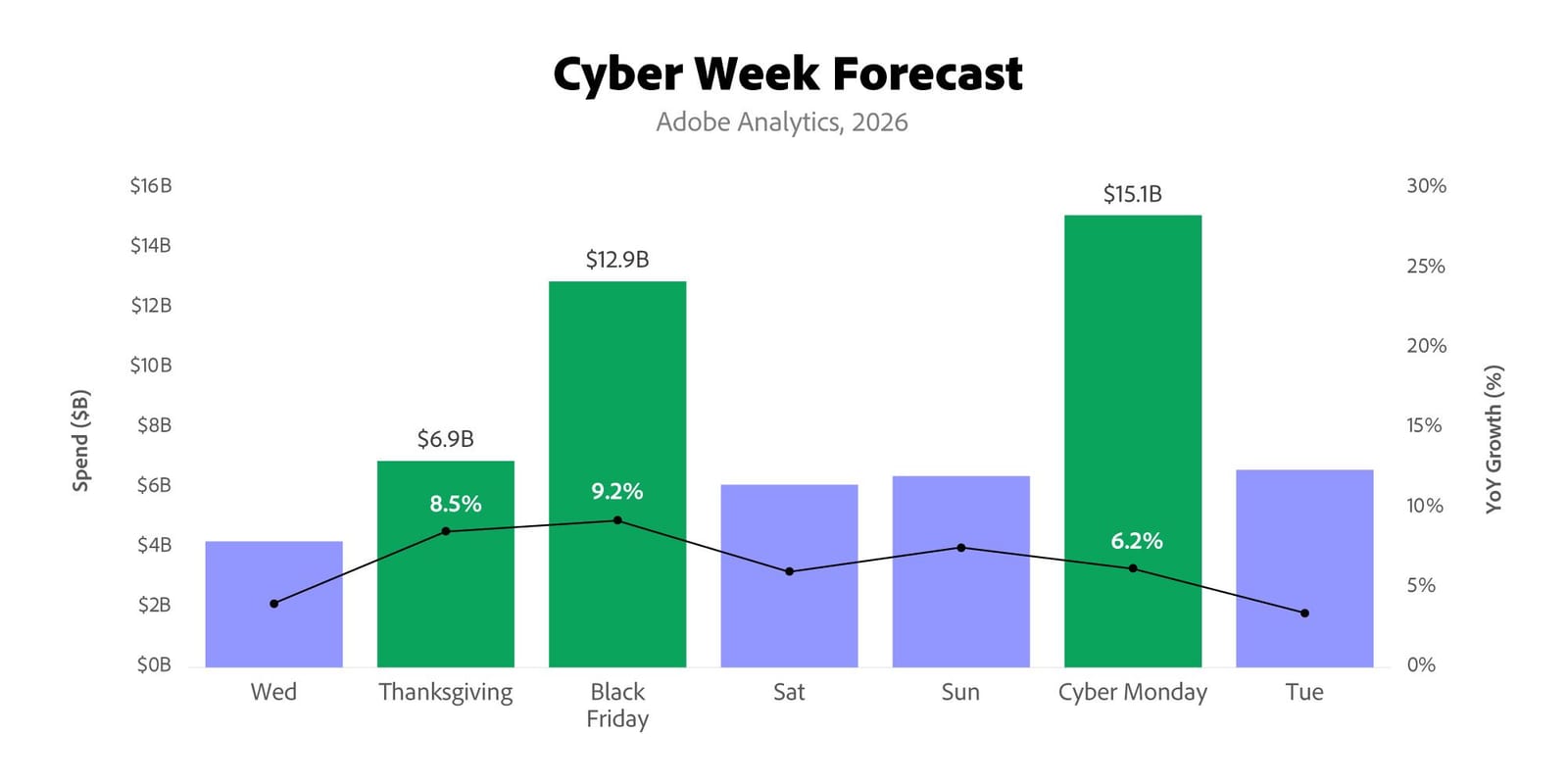
Adobe forecasts U.S. Black Friday online sales of $12.9 billion in 2026, up 9.2% year over year. Cyber Monday is expected to reach $15.1 billion. Promotions remain an important part of the shopping season.
The timing of peak discounts also varies by category:
- Black Friday, November 27: TVs, toys, apparel, appliances and furniture.
- Cyber Monday, November 30: Electronics and computers.
- Thanksgiving, November 26: Sporting goods.
Source: Adobe - 2026 U.S. Holiday Shopping Forecast.
The question is not whether to discount. It is whether increasing the discount further is the best use of margin.
Paul Christopherson illustrates the economics in his LinkedIn post: a product with a 60% gross margin that receives a 30% discount can see gross profit per order fall by half, assuming the discount is applied to the original selling price and other costs remain unchanged.
The store would then need twice as many orders to generate the same gross profit.
This is an illustrative calculation. Actual profitability also depends on fulfilment, payment fees, advertising and other variable costs.
There are other ways to structure promotions. Michael Galvin's BFCM advice, for example, emphasizes giving VIP customers early access rather than simply lowering prices further for everyone.
Michael Galvin@EcomMikeGalvinYour biggest Black Friday revenue day can still leave you with less profit and a worse January.
Here's what I'd put in a DTC brand's BFCM plan:
• Pick products with stock and margin behind them. Check bestsellers, bundles and shipping capacity before writing the offer.
• Write down the offer rules: eligible products, minimum spend, stacking, subscription terms, start and end time. Assign someone to create and…Nov 7, 2026 · View on X
Bundles, gifts with purchase and offers focused on higher-margin products can also be worth evaluating.
The right choice depends on the objective: customer acquisition, average order value, retention or inventory clearance. A discount without a clear commercial purpose may simply give away margin.
Before increasing your discount, check these two things
BFCM preparation now needs to cover both product data and the storefront experience.
For AI discovery
- Audit product information. Check titles, descriptions, variants, attributes and identifiers for accuracy and consistency.
- Verify commercial data. Make sure prices, sale prices, inventory and availability are current across relevant shopping channels.
- Complete purchase information. Provide accurate shipping, delivery and returns details in formats the relevant systems can access.
For human shoppers
- Show the offer immediately. Display the discounted price, promotion conditions and eligible products prominently on mobile.
- Explain shipping before checkout. Make delivery costs and free-shipping thresholds easy to find.
- Surface returns information. Place important return conditions close to the purchase decision.
Start with your best-selling product. Open its page on an actual phone, then inspect the product data available through your catalog and connected shopping channels.
If the information is incomplete, fix it before expecting AI systems to interpret the offer correctly. If the page is confusing, fix it before assuming a larger discount is necessary.
Adobe's forecast suggests that retailers will enter the 2026 holiday season with discount levels broadly similar to last year's benchmarks. At the same time, shoppers are gaining new ways to discover and compare products.
The Shopify stores better prepared for BFCM 2026 will be those whose product data makes sense to AI and whose offers make sense to people.
Ask AI next
- What specific steps enable WebMCP and Shop.dev agent compatibility on a Shopify store?
- How can a seller check whether AI agents or crawlers are actually visiting their own Shopify store?
- What tools can audit a Shopify product catalog for AI-agent readiness before Black Friday?
- Which AI assistants currently support completing a purchase through Shopify's agentic commerce infrastructure?
- What signals would show agentic commerce purchases, not just AI-assisted browsing, are becoming significant this season?